Doufeu Test 1: Cider Braised Pork Shoulder with Pears and Thyme

I do enjoy a cooking challenge. So, when our local Le Creuset store manager Joseph asked if I would like to test my recipes in their signature Doufeu, I said SURE!—even before I knew what in the world a Doufeu is.
I did some hasty internet research.
In French, Doufeu translates loosely to Gentle Fire. This rather handsome cooking vessel (LOVE this color: cerise, or cherry red!) was introduced in 1935, and is now being brought back as Le Creuset honors its 75th anniversary (while celebrating 85 years of making their revered enameled cast ironware.)
This deep oval “French Oven” has a couple of distinguishing characteristics that enable it to slow braise with minimal liquid, yielding tender meats layered with rich flavors. It’s all in the design of the lid.
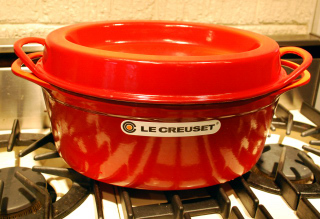
The outer indentation holds a mound of ice. The lid’s underside has a series of little knobby spikes. As the Doufeu cooks, steam rises within, meets up with the chilled top. Condensation occurs, and drips liquid–via the little nodules–back down onto the roast.
Effectively, it self-braises. Nice science lesson!

For my first test, I chose a Pork Shoulder, which benefits from long, slow cooking. In Tennessee, this cut most often makes its appearance on the smoker, hickory-charred and pulled for barbecue. But, braised in cider with pears and thyme, it melts into succulence, the meat bathed in savory-sweet juices: wonderful winter fare served over brown rice.

TIPS: Preparation is simple. After trimming excess fat, liberally season the shoulder with salt, black pepper, and thyme. Heat the Doufeu doucement, gently. The initial searing of the meat is critical. Take time to achieve good browning on all sides before adding the pears and vegetables—you’ll be rewarded with a full-flavored broth.

Browned pork roast, sliced pears, onions, carrots, and leeks only require 1 cup of cider as braising liquid. Secure the lid, fill with ice, and let the Doufeu do its job…..for the next 6 hours!

Six hours, you say? Mais, oui.…I took the Gentle Fire notion very literally….perhaps too seriously. I had my gas burner on its lowest setting. The beauty of LeCreuset is that its very material allows heat to build—and hold. The ice was completely melted after the first hour.
After 3 hours, I decided to peek inside. Wow! The shoulder and accouterments were steeped in this marvelous stock. I flipped the shoulder over, reset the lid, and let it continue….
It filled my home with wonderful aromas.
After almost six hours of Low-and-Slow, the pears and veggies had all but disappeared into the broth. The shoulder was so tender; I easily pulled its singular bone out clean. I removed the roast from the pot, skimmed the stock and thickened it slightly with a Slurry ( cornstarch mixed with water.)
This is not meat to slice. You pull it. You chop it up. Then, return it to that amazing gravy. Surprising: with minimal cider and fruit, it was infused with peary sweetness.
I served this lush roast , alongside brown rice, asparagus, and a salad to my Book Club. The six pound shoulder had remarkable yield–Ten of us enjoyed dinner, and there were leftovers to serve another eight!
Everyone remarked on its soft richness, and the distinct layers of flavors–fruit, vegetal, earth, meat…
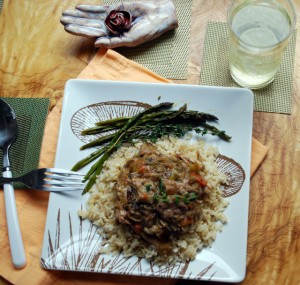
Cider Braised Pork Shoulder with Pears and Thyme
approx. 6 lb. Pork Shoulder, trimmed of excess fat
Salt and Black Pepper
few sprigs of fresh Thyme
Olive Oil
1-2 Leeks, cleaned and chopped
3 Carrots, diced
1 Onion, sliced
4 cloves Garlic, minced
2 Anjou Pears, sliced
1 cup Apple Cider
Season pork with salt, pepper, thyme. Heat the Doufeu on medium, add olive oil, and brown the shoulder on all sides. Lower the heat, add sliced pears, onions, carrots, leeks, garlic, more thyme. Pour in the cider.
Cover, and fill the lid with ice. Simmer along for 3 hours. Flip the roast.
You can “redo” the lid with new ice, if you want—or just leave it filled with water. Simmer at least another 2 hours. (The bone will pull out easily.)
Serve over rice, egg noodles, or roasted potatoes.

Our next Doufeu Test will be with Beef Brisket….
Posted in Meats/Poultry, Recipes | 16 Comments »
High School Cooking Class: meatballs!

That’s Kara, intent on carefully stirring this big batch of Italian meatballs in hearty red sauce, the centerpiece of a meal made by her and fellow Brentwood Academy students attending our cooking seminar at Second Harvest.
For Winterim, she and eight others chose to come to our Culinary Arts Center to learn some kitchen skills and tasty recipes.
We are fortunate at our food bank to have a teaching kitchen. Each week, volunteers get hands-on experience in a commercial setting, preparing our Friday First Harvest Cafe buffet lunch.
Mark and I also feel strongly about teaching youth to cook—informing the palate and developing skills in the kitchen are as critical as reading, math and science (all of which come into play with understanding recipes, measurements, temperatures….)
We have designed a series of classes specific to teens. Periodically during the school year, we host these three-day seminars. On the first day, the kids make a big lunch for themselves. The next day, they cook a full course dinner to bring home to their families. The final day, they assist with our First Harvest Cafe: cooking and serving for the hundred-plus guests who attend.
In the summer, we offer COOKS RULE, week-long cooking camps that expand on some of the skills and recipes touched on in the smaller seminars. We have sophisticated menus exploring cuisines from around world and incorporating fresh local products from our farmers.
For this class, our students learned some Italian-American basics:
meatballs, tomato sauce, pasta, salad and red wine herb vinaigrette
The morning was spent preparing our lunch.
I developed these recipes to be straightforward and simple, without sacrificing flavor, and have found them to be well received by just about anyone interested in learning to cook. I’ve taught them to teens and to formerly homeless. Mindful of what people have access to, the meatball and sauce recipes indicate options for fresh or dried herbs.
We always emphasize that recipes are starting points, guideposts: free to adapt as you choose. It’s all about creativity. Cooking is foremost an art. Happily, there are myriad variations of meatballs and sauce out in the world, and there’s always another tasty take on a known dish.

Our students work in teams. We strive to have a good balance of lecture and demonstration with mainly hands-on work. And, really, that’s why they are there. Everyone wants to get her hands in the action. Mixing and rolling meatballs is a perfect means…..

Plus, it is a WHOLE lot of fun. We strive to have joy in our kitchen.
But, truly, that’s something we don’t have to work hard to achieve!
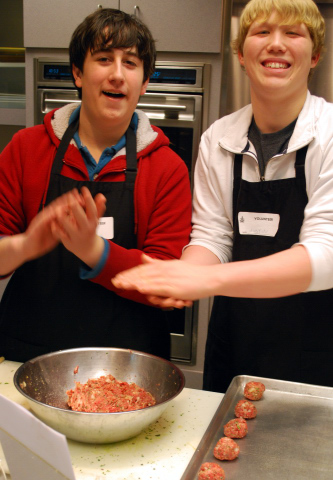
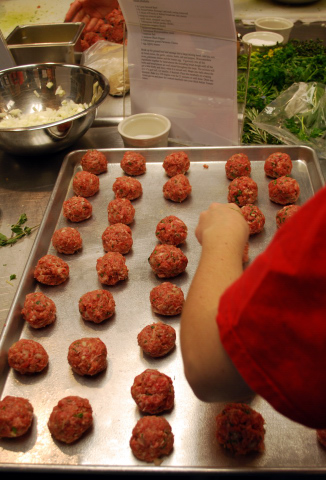
The meatballs are oven roasted. It’s an easy way to cook them, and drain off any excess grease before they are plunged into the pot of red sauce to simmer. (Of course, big batches of meatballs can made, roasted, and frozen—ready to use at a later point in time.)
While the sauce simmers, the students clean, spin, and toss greens with a vinaigrette they whipped up themselves. We prepare the pasta (linguine in this case) and set up our buffet…dine on our reward, a delicious lunch. Good work!

Italian Meatballs
1 lb. Lean Ground Beef
¼ lb. Sweet Italian Sausage, casing removed
2 -3 slices of French or Italian bread, torn into small pieces
2 teaspoons minced Garlic
1 small Onion, chopped very finely
2 Tablespoons dried Italian herbs (or finely chopped 2 T. fresh basil, 1 T. fresh oregano, 2 t. fresh thyme, 1 t. flat leaf parsley)
1 Tablespoon Worcestershire sauce
1 teaspoon Salt
½ teaspoon Black Pepper
6 Tablespoons grated Parmesan Cheese
1 egg, lightly beaten
Break up the ground beef and sausage into a large mixing bowl.
Add the bread pieces, garlic, onions, herbs, salt and pepper, Worcestershire sauce, parmesan cheese and the beaten egg.
Vigorously mix all the ingredients together by hand-almost like kneading bread dough-until all the herbs and bread pieces are well mixed throughout the meat.
The mixture will get a little fluffy and shiny when it is mixed well.
Shape into balls-about the size of a golf ball, (or smaller, if desired). Place the meatballs on a baking sheetpan.
Bake in a 350 degree oven for 25 minutes or until done.
Drain any excess grease and place the cooked meatballs into your thick Italian Tomato Sauce.

Hearty Italian Tomato Sauce
3 Tablespoons Olive oil
2 small Onions, finely chopped
3 cloves Garlic, minced
1 large (28 oz.)Can Tomatoes in juice-coarsely chopped, save the juice!
1 small can (6 oz) Tomato paste
1 Bay Leaf
1 Tablespoon Balsamic Vinegar
1 teaspoon Salt
½ teaspoon Black pepper
1 Tablespoon Basil
2 teaspoons Oregano
In a large saucepan (3-4 quart size) heat olive oil.
Add the chopped onions first and sauté until soft and translucent-about 7 minutes.
Then add the garlic and cook for another minute or so, stirring constantly.
Add the coarsely chopped tomatoes and their juice, the tomato paste, all the herbs and spices and stir well until it begins to boil. Reduce the heat and simmer for an hour, stirring occasionally.
Add cooked meatballs and continue simmering. Taste and adjust for seasoning.

Posted in Meats/Poultry, Pastas, Recipes, Sauces | 9 Comments »
Fascinating and a little different: chocolate zucotta-domed chocolate cake

Wheeeee! This crazy, verging on Mardi Gras, merry-go-round of chocolate decadence, this Amazonian cupcake, was my creation for my mom’s 80th birthday–just celebrated Sunday. Its ingredients were inspired by her abiding love of chocolate in its myriad forms, and its wack-a-doodle look was inspired really, by her joyous take on life.
My mom has always had boundless energy and interests: watercolor artist, art and music teacher, girl scout leader, bowler, bridge player, NYTimes crossword puzzler. She turned her wedding dress into curtains, turned our garage into a craft cranny workshop, turned every picture in the house upside down to see if my dad would notice.
The little string of phrases underneath her senior picture (from the 1948 annual “The Crusader” Mary Louis Academy–an all girls Catholic high school in Jamaica, Long Island, New York) , particularly the last one, always makes me smile:
“pretty as a picture…plays a solid saxophone….laughing brown eyes…
…Fascinating, and a little different.”
Yes, ma’am. To honor this fascinating-and-a-little-different person, I made two cakes into one. The base was a triple-layered sour cream chocolate cake: dark, dense yet moist. The domed top was a chocolate-mousse filled zucotta–incredibly rich yet light: a spectacular (and simple) dessert alone.
From the Italian zucotto for “Skullcap”, a zucotta is a ladyfinger lined, mousse-filled bowl. When chilled and inverted, it makes a cool dome shape that can be further embellished with a smooth coating of ganache.
When placed atop an already over-the-top dessert it became a wild monument to chocolate: a monument whose assembly nearly ended in disaster . The dome almost toppled mid-flight before its precarious three-tier landing. And then, the construction reminded me of a thatched beehive hut we visited in Ethiopia. Yes, this creation was shaping up to be a contender for Cake Wrecks.
Be assured, there is much that can be remedied with more frosting, a long cake spatula, and a pastry bag filled with cocoa whipped cream. And the notion that, when something is meant to be ostentatious, More is Better.
The recipes that follow will make 1 large zucotta–which will serve 12-15, and 1 10″ layer cake to split or 2 9″ layers. Either Zucotta or Sour Cream Chocolate Cake is Lovely-Lovely by itself—you don’t have to go All Fascinating and Little Different if don’t want to!

Chocolate Zucotta
one 4 qt. glass bowl
2 pkgs. plain Ladyfingers
9 oz. Bittersweet Chocolate, coarsely chopped
12 T. unsalted Butter, cut into small pieces
4 T. Espresso, or strong Coffee
2 T. Vanilla
3 T. Crème de Cacao
6 Eggs, separated
1/2 cup Sugar
1 cup Heavy Cream, lightly sweetened and whipped
Line the bowl with plastic wrap, with ends coming over the sides.
Then, line the interior of the bowl with ladyfingers. Brush with creme de cacao and set aside.
In a heavy 1 qt. saucepan under low heat, melt the chocolate and coffee together.
Whisk in the vanilla and creme de cacao. Then, stir in the butter, one chunk at a time, until it becomes smooth and shiny. Remove from heat.
Using an electric mixer and balloon whisk, beat the egg yolks and sugar together until the yolks become really pale yellow and thickened, almost triple in volume. This will take several (at least 5) minutes. The yolks will cling to the whisk.
Your chocolate mixture should be warm—but not hot.
Beat it into the thickened egg yolks, and pour into another large mixing bowl.
Clean and dry your mixer bowl and whisk. Beat the egg whites until stiff and glossy. Fold the whites into the chocolate mixture.
Fold in whipped cream. Pour mixture into lined bowl. Cover with plastic wrap and refrigerate for at least 4 hours, or overnight.
When well-chilled and set, unmold onto a platter or plate. Skim-coat with chocolate frosting and/or Cover with chocolate ganache. Decorate with fresh strawberries, whipped cream.
Chocolate Ganache
1 cup Heavy Cream
1 cup Semi-Sweet Chocolate Chips
1 t. Vanilla
Heat cream gently–to a simmer. Stir in chocolate chips and vanilla. Stir until melted and glossy. Remove from heat. While warm, but not hot, pour over the zucotta. Chill and serve.

I used a 4 qt. glass bowl, with a diameter similar to the cake. Short on time, I used packaged ladyfingers, although I have recipe posted here for them, if you’d like to make them yourself.

This filling is similar to my basic wonderful chocolate mousse, although this recipe has whipped cream folded into the batch.

After this sets up—-overnight is best—-it unmolds quite easily.

Here, I “skim-coated” the zucotta with some sour cream chocolate frosting, left over from the cake. It’s now ready for the dark chocolate ganache.
Sour Cream Chocolate Cake
2 oz. Unsweetened Chocolate
1/2 cup chopped Bittersweet Chocolate
1/2 cup Cocoa
2 sticks Unsalted Butter
2 cups Sugar
1 cup Coffee
1 cup Sour Cream
1 T. Vanilla
3 Eggs
2 t. Baking Soda
1/2 t. Salt
2 1/2 cups All Purpose Flour
In a microwaveable bowl, place the first 5 ingredients and heat for about one minute–until chocolate and butter is melted. Remove, stir, and heat again for another 1/2 minute, so that sugar is dissolved.
Stir in coffee, vanilla, and sour cream. Beat in eggs, one at a time.
Sift flour, soda, and salt together. Beat into wet mixture.
Pour batter into greased 10″ cake or springform pan or 2 9″ cake pans.
Bake in 350 degree oven 35-40 for the 10″/25-30 minutes for the 9″.
Cool. Split 10″ cake to frost.
Sour Cream Chocolate Frosting
1 1/2 cups Semi-Sweet Chocolate Chips
1/4 cup strong Coffee
2 sticks softened unsalted Butter
1 t. Vanilla
1 cup Sour Cream
3 cups Confectioners Sugar
Melt chocolate chips and coffee together–stir until smooth.
Beat softened butter with vanilla. Beat in sour cream, cooled (but not hard) chocolate. Beat in confectioners sugar, one cup at a time.
Taste for sweetness and adjust.

Crazy-Messy, and Oh-So-Good. Voted best cake ever—and best party ever—by the River Rest residents….
Posted in Chocolate, Desserts, Recipes | 15 Comments »
Snow Day Bread and Soup

It has been at least eight years since we’ve had REAL snow in Nashville, the kind that starts in the morning as flurries and builds throughout the day, big fat clusters tumbling down, blanketing the trees, the front yards, the roads, diffusing light, muffling sound…. ultimately bringing the city to a standstill.
Wow. It got really quiet.
And, while I was home, cozy (and succumbing to a headcold), I decided to enjoy the snowy shut-down by making simple comforts: bread and soup.
I had enough of the necessary ingredients: and handful of vegetables for the soup pot, some flour and an unexpired package of dry yeast for bread. These are, after all, basic foods.

With broccoli as the star, mirepoix the reliable supporting players, and potatoes comprising the creamy base, it doesn’t take long to make this hearty soup. It also isn’t essential that you add any dairy to achieve richness, although a modest cupful of lowfat milk added at the end is rather nice. A few shavings of sharp white cheddar, too.
But this is a much lighter version of Broccoli-Cheddar that is often served out in the world, all floury and cheesy and fat-laden.
The potatoes add the creaminess, body to the soup. As they cook along, they all but disappear.
like under a blanket of snow.

Chunks of potatoes will break down, adding flavor and body to the soup.

The soup is beginning to thicken, a good time to add the broccoli florets.
Creamy Broccoli Soup
3 T. Olive Oil
4 medium Russet Potatoes, peeled and diced
1 head Broccoli, stems and florets separated, stems chopped
2 medium Onions, chopped
3 Carrots, chopped
3 Celery, chopped
3 cloves Garlic, minced
3 1/2 qts. vegetable stock, or water
Salt-n-Peppa to taste
1 cup lowfat Milk
1/2 cup shredded Vermont Cheddar
Warm olive oil in a stockpot on medium heat. Sauté the diced potatoes for 5 minutes. Add broccoli stems and the mirepoix (carrots-onions-celery) and stir into the mix, sauteing another 5 minutes. Stir in the garlic and season with salt and black pepper.
The vegetables will begin to soften, and stick to the bottom and sides of the pot. Keep stirring, then add the vegetable stock (or water)
The soup will get a glazy thickness to it. Add the broccoli florets to cook into the batch last. Once they are softened, taste for salt and pepper. Stir in a cup of milk and some shredded Vermont Cheddar for added dairy richness and tang.

And now, for the bread part…….

The thing about bread is Time.
That’s all. And it’s not time where You are actually doing anything—it’s the yeast that’s doing all the work. After you mix up the dough, you just have to check in on periodically, give it a punch, knead it and leave it be. And, put it in the oven to bake.
So, I amend that—it’s really about Patience. It’s worth it. I would like to bake bread more than I do—I am not mindful enough to put it into the plan of a day. And while the recipe for this Rosemary Cracked Wheat Bread is not exceptional, I share it to encourage you.(and myself!) It’s not hard. It’s fun. And, delicious. Just simply to get in the kitchen and bake!
Serve the crusty loaf warm, with a slap of butter on it.
Or, get out your fave olive oil, dress it up with a few strips of sundried tomatoes, polka dots of balsamic….carve a little parmegiano-reggiano….

Rosemary-Cracked Wheat Bread
1 cup warm Water
1 package Active Dry Yeast
1 T. sugar
2 t. Sea Salt
2 T. Olive Oil
1 cup Cracked Wheat Flour
1 1/2 -2 cups Unbleached White Flour
2 T. chopped fresh Rosemary
Stir yeast and sugar into warm water. Yeast will begin to activate–bubble. Add salt and olive oil. Add cracked wheat flour and at least 1 cup of the unbleached white flour and make a soft dough. (add more white flour if necessary.) Knead until elastic. Form into a ball and place into a bowl. Cover with a damp cloth and allow to rise in a warm place for an hour. Punch down again, reform into a ball.
Score with a knife, sort of criss-cross fashion.
Brush with olive oil, sprinkle with coarse sea salt and chopped rosemary.
Let rise for another 45 minutes.
Bake at 375 degrees for 35-40 minutes. Crust with be nicely golden and the bread will “thunk.”

Posted in Breads, Recipes, Soups/Stews, Vegan | 16 Comments »
 AVAILABLE AT THESE ONLINE RETAILERS
Amazon,
Barnes and Noble,
Books-A-Million, and wherever books are sold
AVAILABLE AT THESE ONLINE RETAILERS
Amazon,
Barnes and Noble,
Books-A-Million, and wherever books are sold




- Shrimp-Sweet Pea-Rice Croquettes
- One-Hour Cheese! review, recipes, and a giveaway
- Saltimbocca, sort of
- Ebinger’s Legendary Blackout Cake
- Asparagus Times Two
- Lemon Lemon Lemon Chicken
- Spring Supper: Fennel braised Pork, Beets-and-Blue Salad
- Fresh Starts: Sourdough and Spring
- Indonesian Bami Goreng and a giveaway
- Gastrique Mystique


Cooking programs for youth and teens.

- Feed a Child, Nourish a Mind
A Perfect Apple Tart, and a Peek into Luisa Weiss's Berlin Kitchen
A Place at the Table
Good Things to Come
Home Remedy
Interlude: Urban and Rural Delights
Lamb with Spinach, and The Honey Thief
Lemonade and the Literature of Food
Pura Vida
Ricotta-Making, Spiced Peach Salad and a Review
The Game of 7
Three Gratitudes
Welcome Volunteer