Three Gratitudes

The mysterious ways of the orchid elude me.
For over ten years I have owned one such Phalaenopsis, a Moonglow by name, and I am happy that I have managed to keep it alive. But, I can never know, or predict, if it will bloom. Or not. And, I would say that for the past five years, possibly six, it’s been A Not.
Oh, it has sent out abundant gnarly roots, grey-green tangles that have scrambled over the pot, seeking…what? It has grown measurably taller, leaf after leaf. And so, I have continued watering my orchid, rotating it in the window, keeping it out of direct sun.
But this January, something different was stirring. Who can say what inspired, or prompted this dramatic move out of dormancy. One morning, when watering, I noticed not one but two protuberances–and not at all rootlike, but stalks, actual stems!
For the past several weeks, I’ve watched as both have grown long and winding on their sunroom table perch, seeking light, sending out a series of buds along the branch..
Which have now opened up, these Moonglow blooms. Breathtaking, Times Two.

Last week roaming the grocery store aisles, I stopped and rummaged through a cart filled with reject or discontinued items. Usually there’s nothing I would ever want: post-Christmas candy canes, failed blends of baby food, hair straightener…but every now and then, well, ya never know. There could be a prize. Once I found some very pricey imported pasta, pappardelle from Italy, packed in a long box like a dozen roses, and sold for the cost of Kraft mac-and-cheese.
This time, what caught my eye were two boxes of Maldon Salt. Gasp! Yes, bonafide, from the UK, those natural sea salt flakes, chips, sparks of true pure saltiness, cherished by chefs ’round the world. One of the best of finishing salts, really.
Curiously,the boxes carried neither original nor markdown price.
“Maldon Salt is pretty dang expensive,” I sort of announced to myself and a couple of befuddled shoppers nearby. I’d never seen it on the store shelf, and so tossed the box into the buggy (our dixie term for shopping cart), figuring I’d find out the price at checkout. If it was in an affordable range, then it was a buy.
I presented my checker with the Maldon and my request.
“So, this is the Rolls-Royce of salt?” he said.
“Something like that,” I smiled.
Nothing scanned at checkout; the store manager was called over to do a price check on our special salt. After a while, she returned with her register key and punched in a series of numbers which rung up Sea Salt $1.79.
My eyes widened. So did my checker’s. “Rolls Royce for the price of a Hyundai.”

There’s so much stuff in our physical world; whatever thing you might need or want is bound to be out there, somewhere, I’m convinced of it. It’s a simple matter of asking.
I’m working on an article for Relish Magazine about “Magic Cobblers” with recipes that, instead of traditional 9″x13″baking pans, use uncommon, individual porcelain containers for serving. Containers like latte cups, sherbet bowls, and now, these little Le Creuset hearts.
I had no idea that the maker of enameled cast-iron cookery now makes assorted items in porcelain. And when Joseph, the LeCreuset store manager, learned that I was looking for something a little different for my story, he came through with these perfect heart-shaped crocks to do a magic cobbler recipe test. So nice! So helpful. Sweet.
Wishing you all a pleasant week, graced by those simple unforeseen gifts that surround us.
Your friend,
Nance

Posted in Articles | 10 Comments »
A Pasta e Fagioli, heading into Spring

“If there’s one thing I can do, I can grow leeks.”
That was Gigi’s pronouncement, as we trudged, shovels-in-arms, up the hill to the sunny patch where a long row of leeks stood tall and fat in the ground.
But as we surveyed the rest of her Wedgewood Urban Gardens, we leek-diggers were most amazed—and thrilled—to find an array of other good things growing. Mother Nature was doing what she does best, mostly unattended:
Thyme and tarragon, rumpled spinach,
Chives and spring onions, feathery carrot greens,
shoots of sorrel, cilantro, rainbow chard,
Big tufts of curly kale.

Very quickly, the idea for my community pot luck dish took shape.
I had a package of Heirloom Borlotti Beans (from Rancho Gordo, yes!), several pints of a very prolific peach tomato that Gigi had canned last summer (She can grow those, too!) and now a raft of leeks, chives, and kale. How about a sort of Springtime version of Pasta e Fagioli: Pasta and Beans?

Rather than begin with the usual suspects, onion-carrot-garlic-celery,
this base is All Leek. Sauté the color of spring in some fruity olive oil and give plump borlotti beans a tumble in the greens before adding water and tomatoes.

After simmering for about two hours, the beans become firm but tender. Add the torn-up, crinkly kale leaves to collapse into the stew, and sprinkle in some crushed red pepper flakes. The kale is a wonderful add-in here, those crinkly leaves sop up the flavors and mellow, while retaining tooth.
Something about Gigi’s lemon-colored tomatoes nudged me to take that citrus sensibility a step further, and I sliced a lemon, squeezed a little juice into the pot, and plopped in the fruit, rind and all.
Lovely. That acid tang compliments the nutlike bean, smooth pasta, sweet spring earth of leek. It adds more light to the dish. Perfect, as the sun adds more light to each day…
Oh, and about the pasta: You can put in whatever sort you’d like–small bits are best, saved for the last ten minutes of cooking. Since I have it on very good authority
that it is perfectly acceptable—possibly preferable—to break up ribbons of tagliatelle (but never spaghetti!) into pieces for the pasta component of the dish, that’s exactly what I did!
To Spring!

Heading into Spring Pasta e Fagioli
4 T. Olive Oil
4 Leeks, cleaned and chopped
Salt and Black Pepper
1 lb. Borlotti or Cranberry Beans, soaked overnight
3-4 pints of Canned Tomatoes
1 bunch Kale
Red Pepper Flakes
1 Lemon, cut in half, seeded
1/2 lb. Tagliatelle, broken into pieces
Chives–a handful, chopped
In a stockpot, sauté leeks in olive oil for about five minutes. They will soften and sweeten. Season with salt-n-peppa. Stir in the beans, and let them get well-coated with the olive oil-leek mix before adding water. Add just enough water to cover the beans by an inch or two.
Simmer for 30 minutes and add the canned tomatoes, juice and all.
Simmer, covered, for another 45 minutes. Add the kale and a dusting of red pepper flakes. Squeeze in the lemon juice and toss in the rest.
Simmer another 30 minutes. Taste for salt, black pepper, and red chili heat.
If you want the Pasta e Fagioli thinner, add more liquid (water, tomato juice, vegetable stock) If you’d like it Stand-up Thick, mash a few beans and let it simmer, uncovered.
Break up pasta into the pot, stir in, and cook until pasta is cooked. Garnish with some chopped chives, if you like, and serve.
Makes a Big Batch. (4 qts.)

Posted in Pastas, Recipes, Rice/Other Grains/Legumes, Soups/Stews, Vegan | 11 Comments »
Two Breads: One Soda, One Yeast; Both Quick, No Kidding

Two resolutions intersect nicely in this post. (I enjoy the economy of a such a thing! ) Desiring both to incorporate more whole grains in our diet AND bake more bread, I’d like to share a couple of truly simple and delicious recipes that are done on the fly—in terms of bread-time. Neither requires extensive pre-planning.
One is Brown Irish Soda Bread, here just in time for Saint Patrick’s Day. Whole wheat and rye flours are mixed in with unbleached white, which gives added dimension of flavor to Ireland’s national dish, without added heaviness. A handful of currants are just right for a little pop of sweet, pleasant background interest.
From start to finish, this baking project takes under an hour, and rewards your efforts with two pretty loaves.

Maggie and I baked this together in her kitchen, and used her buttermilk. What a good find! Organically produced, it was not reduced in fat; its rich, luxurious pour contributed to the bread’s supple texture and subtle tang. If you can find whole buttermilk, I recommend it.

Rather than make one large loaf, we divided the dough into two rounds. We brushed a little melted butter over the top and sprinkled some currants before placing in the oven to bake. And then, we waited—-but not long. Just enough time to brew up a small pot of coffee…..

Who knew that so few ingredients could make something so good?
The other is Focaccia, such an easy yeasted, flatbread! With minimal kneading, it only has to rise once!

Again, combining a variety flours, I baked this one with a topping of frizzled leeks, olive oil, and flakes of crystally Maldon Salt.

If you don’t have leeks, use uncooked chopped green onion, which I like almost as much. It reminds me of focaccia used for grilled sandwiches in a little corner cafe in North Beach, San Francisco:
Mario’s Bohemian Cigar Store Cafe.
I discovered Mario’s Bohemian over fifteen years ago, a charming, odd angled neighborhood bar with a minimal menu—terrific sandwiches made with a green onion-flecked focaccia that was freshly baked in the ‘hood, and brought in daily. (I loved the sandwich with grilled eggplant.)
Even though it’s kinda touristy now, it’s so small and still retains its community sense of place. You can get a great cuppa Graffeo coffee there too….beans roasted just up the street.

Of course, the bread is delicious by itself, or as an accompaniment to a bowl of soup. But you might want to try it as a grilled sandwich, in the Mario’s Bohemian manner. Yesterday, Bill had his with this bowl of tomato-vegetable; I had mine open-faced, with a slice of roast beef topped with horseradish cream sauce and greens. We were both very happy.

Frizzled Leek Foccacia
3 Cups Flour: 1 ¼ c. Unbleached All Purpose
1 cup Whole Wheat Flour
¾ c. Rye Flour
1 pkg. Active Dry Yeast
1 cup tepid Water
3 T. Olive Oil
1 T. Honey
1 T. Red Wine (opt.)
1 t. Salt
1 Leek, sliced thinly, sauteed briefly in olive oil and salt
Olive Oil
Sea Salt, Maldon Salt
Stir water and yeast together in a bowl. Add olive oil, honey, salt, wine. Stir in flours until all is incorporated, forms a sticky ball. I added a little wine and honey to this, to give the yeast a little something more to eat. It seemed to enjoy it, and got well activated.
Gently knead for a few minutes to help release glutens.
Cover and allow to rise at least 45 minutes.
Turn out onto oiled baking sheet pan, and gently press out to all sides. Spread leeks over the top, dust with salt flakes, drizzle with a little olive oil. Cover again while you wait for the oven to heat: Preheat oven to 400 degrees. Bake for 20-25 minutes, until top and bottom of flatbread is brown. Remove from oven and allow to cool.

Brown Irish Soda Bread with Currants
1 ½ cup Unbleached All Purpose Flour
1 ½ cup Whole Wheat Flour
¾ cup Rye Flour
1 t. Baking Soda
1 t. Salt
1 T. Brown Sugar
½ -1 cup dried Currants
2 cups Buttermilk
Preheat oven to 400 degrees. Mix dry ingredients together in a bowl. Make a well and pour in buttermilk and currants. Begin working the liquid throughout the flour, dough will be a little wet and sticky, scone-like. Turnout onto work surface and lightly knead. If it’s too wet, add a little flour. Divide and form into 2 balls.
With a sharp knife, score an X across the top, bringing the knife to the edges. This will help the bread rise evenly. Place onto a buttered baking sheet pan and place into the oven.
Bake for 30-35 minutes, until done. The rounds of bread will have a hollow sound when thumped.
Slice and serve warm with a slap of butter on it, and enjoy with a cup of coffee or tea. To the Luck of the Irish!

Posted in Breads, Recipes | 15 Comments »
Polenta Torta with Wild Mushroom Ragu

This past weekend I was in Highlands, North Carolina, a charming mountain community that is home to a number of high-end restaurants. I was there in an unusual capacity—dispatched, you might say, to be one of three judges for their first-ever Iron Chef style culinary competition.
Who would be “King of the Mountain?” Four area chefs faced off, armed with kitchen staples, a box of Secret Ingredients, their sharpened French knives and wits, trying to execute as many daring dishes possible within a 40 minute time period. Yikes, 40 minutes!
And then, we judges got to sample, and score, on the basis of Taste, Presentation, and Creativity….in what seemed seconds.
Indeed, these chefs came up with some exceptional delectables. For one heat, the secret ingredient was sushi-grade Red Grouper. Witness: a gorgeous Grouper Carpaccio, translucent fillet dressed with peppery olive oil, basil and fennel. Grouper and crawfish in a spicy African Peanut Stew, presented in the hollow of a halved coconut. Grilled baby eggplant, mango, and grouper salad in a gingery-caramel-tamari-based dressing that was ultimate Umami.
Inspiring!
It wasn’t until the morning after the competition, while driving the winding way down the mountain, that I started to wonder, what would I have made in 40 minutes…
I didn’t arrive at any great answers. And when I arrived home, I made this Polenta Torta.
Now, even though it is not King of the Mountain caliber, it would score very high points for taste. Mushroom ragu can be as rich and complex as a meat bolognese, and in much less time.
Presentation and creativity score well in the acceptable range.
And, it can be made and assembled in that 40 minute time period…if you’ve got your sharp knife and wits about you.

Polenta Torta layered with Spinach and Mushroom Ragu
For the Polenta:
4 cups Water
1 cup Polenta
1 t. Sea Salt
1 t. good Olive Oil
Bring water a boil and stir in polenta and salt. Stir continuously until polenta incorporates into the liquid. Simmer, stirring occasionally.

Polenta is very forgiving. If it gets too thick, thin with more water. If it’s too thin, just simmer along and it will thicken up. When it is a good, almost pourable consistency, remove from heat and stir in the olive oil.

Mushroom Ragu:
1 T. Olive Oil
1 T. Butter
1 medium Onion, small dice
½ Yellow or Red Bell Pepper, small dice
2 cloves minced Garlic
12 oz. coarsely chopped assorted Mushrooms: portabellos, shiitakes, oyster, cremini…you don’t have to get all of these, 2 or 3 varieties are nice
4-6 sprigs fresh Thyme
Salt
Black Pepper
¼ cup Red Wine
1 cup diced Tomatoes and juice
½ cup low fat Milk
In a skillet under medium heat, melt butter and olive together. Saute onions and peppers until softened; stir in garlic, mushrooms, and thyme. Season with salt and pepper. Saute until mushrooms brown. Add red wine, tomatoes and juice. Stir well, scraping up any browned bits in the skillet. Simmer and stir. Mushrooms will release their liquid and sauce will acquire a pretty reddish-brown hue. Stir in milk; taste for seasonings and adjust.

Spinach Sauté
½ lb. fresh Spinach
2 cloves minced Garlic
Olive Oil
shredded Pecorino Romano
Simple: Heat the oil, toss in the garlic for 30 seconds, then add the spinach leaves. Toss around in the pot until the leaves are coated and collapse. (another minute or two) Remove from heat and dust with a little romano cheese.

Assembly
In a 9×13 casserole dish coated with olive oil, spread a layer of polenta. Follow that with a layer of spinach, then a layer of mushroom ragu. Sprinkle some shredded pecorino romano at this point, if you like.
Repeat the process—all layers again.
At this point, if you are making things ahead of time, you can refrigerate the casserole. It will be ready to bake when you are.
Preheat oven to 350 degrees. Bake for about 30 minutes–until browned and bubbly.

For my Vegan Friends:
Polenta Torta lends itself to numerous variations.
Simply delete the butter and romano; no milk in the mushroom sauce.
It won’t be quite as Lush—but still very good.
Layers of swiss chard and marinara sauce would be Delish.
And, Pesto layers? Absolutely.

Posted in Recipes, Rice/Other Grains/Legumes, Sauces, Vegan, Vegetables | 18 Comments »
Doufeu part deux: Brisket of Beef

Goodness, it’s been unusually Meaty around here of late at Good Food Matters, what with braised pork shoulder, the cauldron of Italian Meatballs, and now this vast platter of beef.
I do promise to bring balance to the blog with postings that feature vegetables, fruits, grains, and the likes. But, in the interest of good experiments, i.e. The Illustrious Vessel, we’ll press forward today with Doufeu, part deux.

For a number of years—-back in The Day—-we catered the large Seder for Congregation Micah. It was a great service offered to their community who were either unable to observe this Passover meal and ritual at home, or simply desired to celebrate it with a group (150-200!) of fellow members.
I am not Jewish, but had many Jewish catering clients, and so I had a basic understanding of what was needed for the service, what was acceptable—from a dietary standpoint—and what had to be avoided. The director of Congregation Micah provided us with all the guidelines, and a copy of the Haggadah, the special text.
Restrictions include: no dairy, no leavened grain, no legumes, corn, or rice.
It was a challenging and rich experience, to design a balanced menu, to properly (and tastefully!) prepare the meal, and serve all the components in their rightful order to so many people.
We learned some fabulous recipes—I make a mean Matzo Ball Soup, just thinking about it now gets my mouth watering!—
It was a great history lesson too, learning how the Seder plate holds symbols in the form of foods to bring mindfulness to the Exodus, the struggle from slavery to freedom.
We always prepared beef brisket, using a recipe given by a client long ago, that slow cooks the meat with onions, chili sauce, red wine, and ginger ale. The results were always remarkable: the beef rich and tender, covered in a sauce thickened with caramelized onions, deepened with wine, spiked with sweet-sour notes from the chili sauce and soda.
With the first day of Passover coming up on March 30th, I thought it would be the perfect time to try out my brisket recipe, with modifications, in the Doufeu.
I am happy to report that the results were Superb.
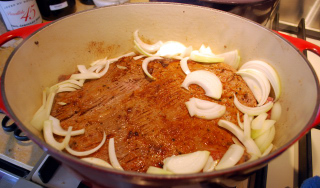
Searing the rub of salt, black pepper, and paprika onto the meat goes far in creating a lovely bronzed brisket—-critical to the braise.

I reduced the amount of liquids in my recipe for the doufeu to achieve the desired flavor profile. Plenty of onion is still needed though!

Brisket of Beef
2-3 T. Olive Oil
6 lb. Brisket, trimmed of excess fat
Kosher Salt
Cracked Black Pepper
Paprika
3-4 Onions, sliced
2-3 Garlic cloves, minced
½ cup red wine
½ cup ginger ale
½ cup chili sauce
Heat Doufeu on low. Add olive oil. Rub trimmed brisket with salt, black pepper and paprika.
Brown the brisket on both sides and remove.
Add about ½ of the sliced onion and sauté for a few minutes. Lay the brisket on top of the bed of onions. Pour over red wine and ginger ale. Spread the chili sauce over the top of the brisket, sprinkle with minced garlic and remaining sliced onions. Cover with lid, fill with ice, and turn heat down to lowest setting.
After 3 hours, remove lid, flip over the brisket. Cover and cook for about 2 more hours.
Meat will feel very tender when pierced with a fork. When done, remove brisket.
Slice brisket thinly, across the grain, and lay out on a serving platter. Cover with hot oniony gravy and serve.

This platter of sliced brisket was much-loved at our last community pot luck!
Posted in Meats/Poultry, Recipes | 18 Comments »
 AVAILABLE AT THESE ONLINE RETAILERS
Amazon,
Barnes and Noble,
Books-A-Million, and wherever books are sold
AVAILABLE AT THESE ONLINE RETAILERS
Amazon,
Barnes and Noble,
Books-A-Million, and wherever books are sold




- Shrimp-Sweet Pea-Rice Croquettes
- One-Hour Cheese! review, recipes, and a giveaway
- Saltimbocca, sort of
- Ebinger’s Legendary Blackout Cake
- Asparagus Times Two
- Lemon Lemon Lemon Chicken
- Spring Supper: Fennel braised Pork, Beets-and-Blue Salad
- Fresh Starts: Sourdough and Spring
- Indonesian Bami Goreng and a giveaway
- Gastrique Mystique


Cooking programs for youth and teens.

- Feed a Child, Nourish a Mind
A Perfect Apple Tart, and a Peek into Luisa Weiss's Berlin Kitchen
A Place at the Table
Good Things to Come
Home Remedy
Interlude: Urban and Rural Delights
Lamb with Spinach, and The Honey Thief
Lemonade and the Literature of Food
Pura Vida
Ricotta-Making, Spiced Peach Salad and a Review
The Game of 7
Three Gratitudes
Welcome Volunteer