Summer Tortellini Salad

Summer is fleeting. I awoke this morning to cool, crisp air moving through the house: 59 degrees! So rare on this last day of August in Nashville Tennessee, so telling of the season to come.
These are days to savor outdoors: Clear skies, warm, steady light. There’s still a bounty coming in the garden–corn, squashes, melons, beans, tomatoes. Basil plants the size of shrubs. Today, we’ll enjoy a lunch made with some of these summer garden elements, and relish them at our backyard table.
This tortellini salad is similar to one we always served at the café years ago–with some updates. For a pleasing variety in color, taste, and texture, I recommend using both green snap and yellow wax beans, if you have them at your disposal. And, this salad is the perfect place to toss in an assortment of grape and cherry tomatoes. I used my Cherub grapes, Husky cherries and the brilliant Sungolds. In café days, I had dressed this in balsamic vinaigrette–long on flavor, but less visually appealing , with its flat brown color. With all my basil begging to be picked, I’m going for a pesto vinaigrette. It delivers the flavor, while allowing the salad to shimmer.

Summer Tortellini Salad
1/2 lb. fresh green beans
1/2 lb. fresh yellow wax beans
1/2 lb. fresh (or frozen) cheese stuffed tortellinis
1 pint cherry (or grape) tomatoes–assorted reds and sungolds
1/4 cup toasted pinenuts
1/4 cup basil chiffonade
1 cup Pesto Vinaigrette
Fill a skillet with water and bring to a boil for blanching the beans. Set up a large bowl of ice water. If you are cooking two types of beans, cook them separately. Wash and snap beans–pinching off the stem and place into boiling water. Blanche for 4 minutes. Plunge into the icy water bath to shock them—stop the cooking process. Drain well and place into a salad bowl.
In the same pot of water, cook the cheese tortellinis, about nine minutes. Drain and add to the bowl with beans. Wash, dry and cut the cherry or grape tomatoes into halves or quarters—depending on size—and add to the salad, along with the toasted pine nuts. Pour vinaigrette over all and toss well.
Garnish with a chiffonade of fresh basil.
You might enjoy this served on a bed of fresh greens, or by itself, with a piece of crusty bread to sop up the dressing.
Serves 6 generously.

Pesto Vinaigrette
1 clove fresh Garlic
1 cup Basil leaves
1 teaspoon Sea Salt
1/2 teaspoon Black Pepper
1/4 cup Red Wine Vinegar
3/4 cup Fruity Olive Oil
Place the first five ingredients into a food processor fitted with the swivel blade and pulse until basil and garlic are well chopped. Then, slowly drizzle in the olive oil while processing, until well-incorporated. Taste for seasoning and adjust if necessary.
Makes one cup.

Posted in Pastas, Recipes, Salads, Vegetables | 5 Comments »
Yes We Can Can

For decades, I have studiously avoided canning. The reasons shifted, serving as a litmus test of where I “was at” in my culinary development, as in:
Canning? How Uncool.
or Canning? You’ve got to be kidding. I’ve got No Time for That.
or Canning is Too Scary. The terms “process bath” and “botulism” freak me out.
and Canning? A messy ordeal. I’ll roast and freeze, thank you.
These days, with a little more time on my hands, and a lot less freezer space, I understand the wisdom of canning.
And now, thanks to Maggie, the relative ease.
Tomatoes are the only vegetables that do not require a pressure cooker to safely can, just a “hot water bath.” So, on to Demystifying the Process.
All that you need is the Right Equipment—mason jars and lids, stockpots, canning tongs, wide funnel–and a couple of leisurely hours. Your ingredients are simply your assortment of lovely, ripe tomatoes, and kosher salt. Fresh basil, too, if you are so inclined.
Maggie points out—and rightfully so–that it’s much easier on you if you work in small batches. Don’t get overwhelmed; you don’t have to make a day of it. We began our process at 9am and had everything complete, tidied up by 10:45. Not bad!
1. Place tethered canning rings on the bottom (this makeshift rack cushions the jars)of your 12 qt. stockpot and fill with water. Bring to a boil.

2.Have a 3 qt. pot of water heated and ready to blanche your tomatoes. Have a bowl of chilled water ready to halt the cooking, post-blanche.

3. Have canning jars and lids cleaned with hot, soapy water, rinsed and dried. Place 1/2 teaspoon kosher salt into each Pint Jar (1 teaspoon salt if using Quarts)

4. Select ripe tomatoes, wash, and dip into boiling water for 30 seconds–or until skins crack. Plunge into icy water and remove. Core the tomatoes, and slip off the skins. Cut into quarters and place into a 3-4qt. saucepan.

5.After you have cored, skinned, and quartered all your tomatoes, bring them to a boil.

6. Using the wide mouthed funnel, ladle the tomatoes into each jar. Place a sprig of fresh basil into some, if you like. Leave about 1/2″ gap at the top of the jar.

7. Carefully wipe off the outer rim of the jar, place seal and ring on top and tighten.

8. Lower jars into stockpot. The jars shouldn’t touch one another, or the sides of the pot. About 2″ of water should be above the tops—add more hot water if necessary. Return to a boil. Process for twenty minutes–counting your time from when the water begins boiling. (in our case, that took about two minutes.)

9. Remove jars with canning tongs. Set out on the counter to cool. After a few minutes, You will hear a distinctive POP–that’s the seal being made.

10. That’s IT! Tomatoes for sauces, soups, stews, a wonderful, candied taste of summer that you will surely enjoy in the dead of winter!
Posted in Recipes, Vegetables | 9 Comments »
Figs, Unforeseen

A beauty of the unexpected is its utter simplicity. As you make your way through your daily tasks, you never know when you’ll come across that thing, be it sound, taste, appearance, a singular moment that lifts a day-in-the-life into the extraordinary.
One day, it was the buzzing return of hummingbirds to the trumpet vine outside my second story sitting room window, just when I had given up on them. Another day, it was my discovery of four football-sized watermelons camouflaged beneath the vigorous growth of our first-time volunteer patch. How clever and sneaky of them!
And just this past Thursday, when I visited my friend Maggie at her country abode, it was a box of fresh-picked figs that she placed on her kitchen counter with the announcement that we were going spend the afternoon making preserves “just like mama’s.”
And Maggie’s Louisiana Mama Knows Figs. Talk about good. Hoo-wee.

Now, the only negative–if you can call it that–to these pleasing unforeseens is that rarely am I armed with my camera to document them. So, you’ll have to take my words and conjure your own pictures of us gingerly selecting and cleaning the figs, occasionally pulling a plump one across our teeth to sample the honeyed goodness. Or skimming off the foam, using the wooden spoon to fold the figs and lemon bits throughout the thickening syrup, taking care to keep the figs intact as they simmered.
We used a recipe from Lee Bailey’s Southern Food as a guideline. It called for destemming the figs and cooking them with lemon and sugar “for 10 minutes or until they’re done.” Well, it took more like an hour and ten minutes of us hovering over the deep skillet, stirring, testing, fretting, waiting for the syrup to thicken, the lemon rind to glaze like candy, the figs to achieve a dense caramel translucence.
“Mama always kept the stems on,” Maggie said. It was more than an aesthetic. “That way you can pluck them out of the jar just so,” she lifted one up daintily with thumb and forefinger, before chomping down with a moan.

At least I can share with you the results.
For Sunday morning breakfast, I found there to be no better way to herald the day than with a macchiato, made by champion barista Bill, and some sourdough toast spread with whole milk ricotta, made by the Cheese Maven Kathleen and these Maggie-and-her-Mama’s Lafayette, Louisiana style fig preserves.
Simply Grand.
Fig Preserves, Lafayette-LA-Way
rule of thumb–for every pound of figs, use one cup of sugar
4 lbs. Figs, cleaned, stem left on
4 cups Sugar
1 1/2 Lemons, sliced
water
Place figs into a deep skillet. Add sugar, then just enough water to dissolve the sugar. Place lemon slices throughout. Bring to a simmer, stirring and folding the figs carefully, sometimes shaking the skillet side-to-side. Skim off the foam as it accumulates. Simmer like this for at least one hour.
The figs will change from purple to brown; the lemon will cook away, and the rind will candy. The syrup will become thick, brown, and glazy.
Place into jars and either cool and refrigerate, or process in a 5 minute bath.

Posted in Fruit, Recipes | 13 Comments »
Deep-Dish Heirloom Peach Roma-Lemon Basil Tart

In honor of our Sixth Annual Tomato Art Fest this past Saturday, I made these thick, savory-sweet tarts and promptly sold them by the slice out of our Local Food Tent. Slow Food Nashville, The Friends of the Nashville Farmers Market, and the Food Security Partners of Middle Tennessee shared side-by-side tents at the festival, giving away tastes of Orange-Tomato-Cardamon Ice Cream, Grilled Trout and Tomato Sandwiches, Mountain Ridge and Bradley tomato bites.
We also had a huge Tomato Bake Sale to raise money for the Food Security Partners. It featured quite the array of All Things Tomato, from tomato-feta foccaccia to green tomato coffeecake, tomato-basil scones, tomato-dill bread, tomato-mozzarella calzones, purple cherokee cherry tomatoes filled with homemade ricotta, tomato-corn muffins, (beginning to seem like a Forrest Gump recitation…)
and this deep-dish heirloom peach roma-lemon basil tart!

The foundation for this recipe came to me many years ago via baker Tonya Marinelli’s mom, Gail. It became an oft-made brunch dish at my catering company, using ripe red tomatoes, genovese basil, baked in a regular pie dish.
Gigi had given me these unique heirloom romas, some peach in color, some yellow, grown in her Wedgewood Urban Gardens. These tomatoes were indeed beautiful–I’d never seen any like them–and, unlike many red romas I’ve eaten, these heirlooms were exceptionally sweet and juicy, with lemony citrus notes. That inspired me to pair them with my lemon basil in the pie, and increase the original recipe by one-and a -half to make it extra tall and rich.
The results:Sublime.
Remember, the recipe can be simply altered to use any variety of tomato and basil you like. I also made one with the bold “Mortgage Lifter” tomato and pesto. It sold out before I could try it, but the word on the street was “day-um.”

Pastry Crust (Pâte Brisée)
1 cup all purpose flour
6 Tablespoons chilled Butter, cut into small pieces
¼ teaspoon salt
4 Tablespoons Ice water
pesto and pine nuts
Place flour, chilled butter and salt into a food processor fitted with the pastry blade. Pulse,until the mixture is blended and like coarse meal. Add ice water, one tablespoon at a time, and process until the mixture gathers into a ball-like mass. Remove, shape into a ball, wrap in plastic, and place in the refrigerator for at least an hour.
Roll out on a lightly floured surface into a 12”circle. Drape over your 9” deep pie or springform pan. Press the dough to the bottom and sides, taking care not to stretch it. Brush pesto onto the pastry surface, prick pie bottom with a fork, and scatter with pinenuts, which double as pie weights.
Bake in a 350 degree oven for 10-12 minutes. Remove and cool before adding the filling.


Deep-Dish Peach Roma-Lemon Basil Tart
1 9” deep pastry shell, brushed with pesto, weighted with pine nuts and prebaked
2 eggs
1 ½ cups mayo
1 ½ cups grated parmesan
1 teaspoon black pepper
½ teaspoon granulated garlic
½ teaspoon salt
4-6 ripe Tomatoes, sliced medium thickness
1 ½ cups chopped fresh Lemon Basil leaves
1 cup shredded Monterey Jack cheese
½ cup shredded White Cheddar
In a bowl, mix until well combined: egg, mayo, parmesan, garlic, salt, pepper.
Cover the bottom of the pie crust with a layer of sliced tomatoes. Top with a layer of chopped basil. Spoon about half of the egg-mayo-parmesan mixture over that and top with shredded cheeses. Repeat the layering. Decorate the top with tomato slices and basil leaves.
Bake at 350 degrees for 45-50 minutes, until golden. Serve warm, or at room temperature. One tart serves 12-15.

Posted in Egg/Cheese Dishes, Recipes, Vegetables | 8 Comments »
Those Curious Zucchini Faux-Crab Cakes

About this time last summer, when everyone was inundated with zucchinis (zounds! zillions!) and seeking something new to do with them, I found this curiously appealing recipe on the ‘net. The blogger (Alas, I have no clue whom to credit!) posted a compelling account, attesting to the veritable crabbiness of these faux cakes. I saved the recipe, but did not get around to trying it until New Years Eve. That’s when Bill and I host our Community Lobster Pot Dinner–which is a whole other story.
Anyway–I wanted to serve Bill, our avowed vegetarian, something “seafoody” while the rest of us were tearing into our lobster tails, dousing sweet chunks in cayenne lemon butter. It seemed like the perfect opportunity for the zucchini faux crabcake.
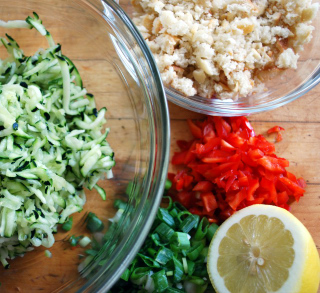
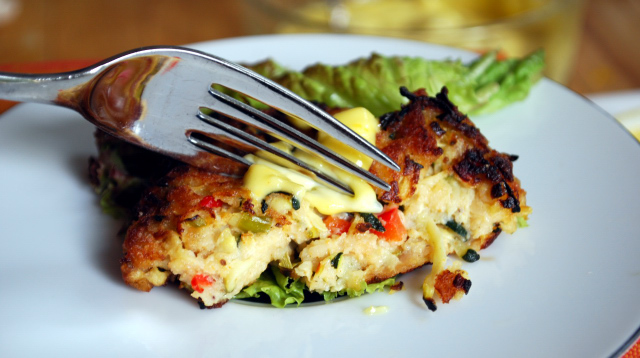
The cakes were simple to make. I augmented the recipe slightly with the addition of green onion, red bell pepper, and hot red pepper flakes and whipped up a little remoulade to accompany.
When it came time to serve that course, an odd thing happened at the dinner table. The guests, with their delectable tails set before them, looked with longing at Bill’s plate of cakes.
“Those look fabulous. Can I have a bite?”
“Wow. These are great.” “I want one.” “Do you mind? Are there extras?”
And so on.
What happened was this: each person had a case of Faux Crab Cake envy.
Now, as cook, I was preoccupied with all the aspects of the meal and did not really sample the zucchini cakes–not enough to confirm their greatness. But, I decided that once the droves of zucchinis descended in August, I would make the faux crabcakes again.
And, here we are.
Verdict: These are very, very good. But, Better than Real Crabcakes? Well, perhaps not—but they were way-superior to many “real crabcakes” that I’ve had the disappointment to dine on in many places, and way more affordable.


Zucchini Faux-Crab Cakes
2 cups coarsely grated Zucchini
Salt
1 cup Bread Crumbs (I used a baguette)
1 Egg
2 Green Onions, thinly sliced–use entire scallion
¼ cup small diced Sweet Red Bell Pepper
1 ½ teaspoons Old Bay seasoning
1 teaspoon Dijon Mustard
1 Tablespoon Mayonnaise (or plain yogurt)
Juice of ½ Lemon
a pinch or 2 Red Pepper flakes
vegetable oil, for frying with a smidge of butter
Place grated zucchini in a colander; sprinkle lightly with salt, allow to stand for 30 minutes,draining. Squeeze to remove additional liquid – zucchini should be fairly dry. Place zucchini, bread crumbs, with all the other ingredients in a large bowl and mix well.
Form into 8 patties the size of crab cakes.
Heat a small amount of oil and butter in a skillet, and cook patties on both sides, browning well. Drain on paper towel.
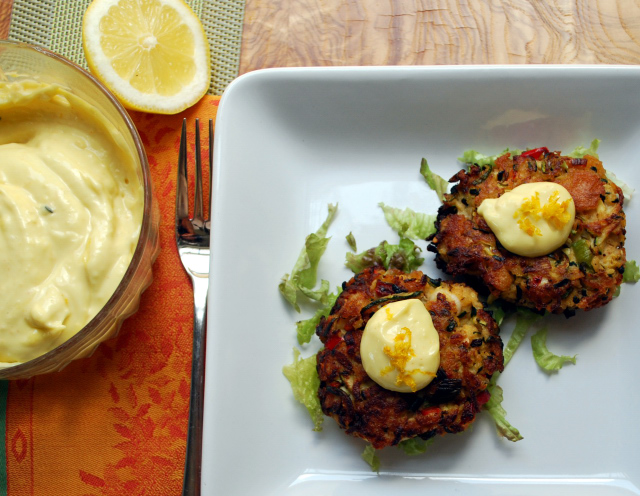
Citrus Remoulade
1 clove Garlic
1 Egg, room temperature
½ t. Dijon Mustard
½ t. Lemon zest
½ t. Orange zest
1 t. Lemon juice
1 t. Orange juice
½ t. Salt
1 cup Olive Oil
Place all the ingredients EXCEPT for the olive oil into a food processor fitted with the swivel blade.
Process for about a minute to break down the garlic into the other ingredients. Then, slowly pour the olive oil into the mix while processing. The mixture will become thick, like mayonnaise (which is what is basically is.)
Posted in Appetizers/Hors D'oeuvres, Recipes, Vegetables | 14 Comments »
 AVAILABLE AT THESE ONLINE RETAILERS
Amazon,
Barnes and Noble,
Books-A-Million, and wherever books are sold
AVAILABLE AT THESE ONLINE RETAILERS
Amazon,
Barnes and Noble,
Books-A-Million, and wherever books are sold




- Shrimp-Sweet Pea-Rice Croquettes
- One-Hour Cheese! review, recipes, and a giveaway
- Saltimbocca, sort of
- Ebinger’s Legendary Blackout Cake
- Asparagus Times Two
- Lemon Lemon Lemon Chicken
- Spring Supper: Fennel braised Pork, Beets-and-Blue Salad
- Fresh Starts: Sourdough and Spring
- Indonesian Bami Goreng and a giveaway
- Gastrique Mystique


Cooking programs for youth and teens.

- Feed a Child, Nourish a Mind
A Perfect Apple Tart, and a Peek into Luisa Weiss's Berlin Kitchen
A Place at the Table
Good Things to Come
Home Remedy
Interlude: Urban and Rural Delights
Lamb with Spinach, and The Honey Thief
Lemonade and the Literature of Food
Pura Vida
Ricotta-Making, Spiced Peach Salad and a Review
The Game of 7
Three Gratitudes
Welcome Volunteer